Document Handling Node
Overview
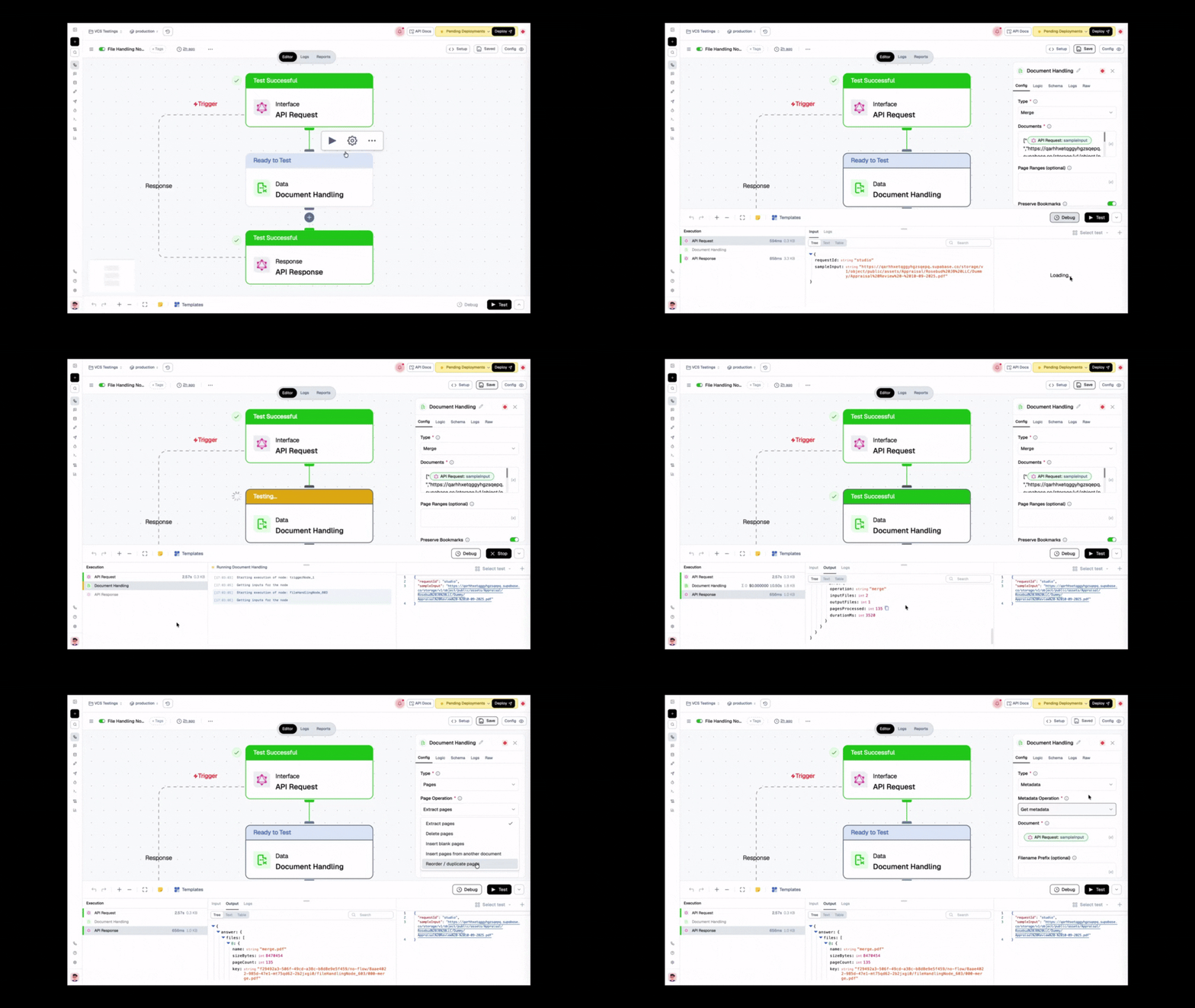
Working with PDFs in a flow used to mean piecing together multiple nodes just to merge a couple of files or pull out a few pages. The Document Handling node does it in one step: pick what you want done, point it at your documents, and get a ready-to-use file back.
It covers 14 operations across five types: Merge, Split, Pages, Bookmarks, and Metadata. You pick a Type first, then the specific Operation for that type, so you only ever see the fields relevant to what you’re doing instead of one long list of every option at once.
Node Type Information
| Type | Description | Status |
|---|---|---|
| Batch Trigger | Starts the flow on a schedule or batch event. Ideal for periodic data processing. | ❌ False |
| Event Trigger | Starts the flow based on external events (e.g., webhook, user interaction). | ❌ False |
| Action | Executes a task or logic as part of the flow (e.g., API call, transformation). | ✅ True |
This node is an **Action** node that merges, splits, and edits pages, bookmarks, and metadata in PDF documents.
Features
Key Functionalities
- Merge: Combine multiple PDFs into one, with optional per-document page ranges and bookmark preservation.
- Split: Break a PDF apart every N pages, at specific page numbers, or into one file per page.
- Pages: Extract, delete, insert blank pages, insert pages from another document, or reorder/duplicate pages.
- Bookmarks: List, set, or remove a PDF’s bookmarks.
- Metadata: Get or set document metadata, title, author, subject, creator, and keywords.
Benefits
- One Node, Not a Chain: Handle common PDF editing tasks without wiring together multiple nodes.
- Only Relevant Fields: The two-step Type → Operation picker keeps the panel focused on what you’re actually configuring.
- Safe by Default: Each run executes in its own isolated container, and documents flow in and out as URLs rather than inline data.
- Predictable I/O: Every operation that produces a file returns the same shape, a presigned URL plus a durable storage key, so downstream nodes always know what to expect.
What Can You Build?
- Merge a cover page, generated report, and appendix into a single client-facing PDF.
- Split a large scanned document into per-page or per-chapter files for downstream processing.
- Strip a fixed cover page or insert a signed addendum into an existing contract.
- Read or stamp document metadata (title, author, keywords) as part of a publishing pipeline.
- Preserve or rebuild a PDF’s bookmark outline when reassembling documents.
How It Works
Drop the node into a flow, provide your document URL(s), and run it. Each run spins up in its own isolated container.
- Inputs are URLs only. Base64 input is rejected with a message pointing you at a URL instead, this keeps whole PDF files out of your workflow state and run logs.
- Outputs that produce a file return a presigned URL and a durable storage key, ready to pass to the next step or store for later.
- List Bookmarks and Get Metadata return their data directly instead of a file.
Two things worth knowing before you rely on this node:
Password-protected PDFs are rejected. The node can’t process an encrypted file it can’t open. Get Metadata is the one exception, it can still inspect an encrypted document without the password.
Some operations (Extract, Insert, and ranged Merge) can drop annotations, outlines, or form fields from the source PDF. This is a limitation of the underlying processing, not a bug, the node UI calls it out directly so it isn’t a surprise.
Setup
1. Merge
Combines multiple PDFs into a single document.
Configuration Reference
| Parameter | Description | Required | Example |
|---|---|---|---|
| Documents | The PDF files to merge, in order. Accepts URLs. | Yes | ["{{node1.output.url}}", "{{node2.output.url}}"] |
| Page Ranges | Optional per-document page ranges. Leave empty to include a document in full. | No | 1-3 |
| Preserve Bookmarks | If enabled, carries each source document’s bookmarks into the merged output. | No | true |
Output
files: an array with one entry:{ url, key, pageCount }for the merged document.
2. Split
Breaks a single PDF into multiple files.
Configuration Reference
| Parameter | Applies to | Description | Required | Example |
|---|---|---|---|---|
| Document | All | The PDF to split. Accepts a URL. | Yes | {{node1.output.url}} |
| Operation | All | Which split mode to use. | Yes | At Specific Page Numbers |
| Pages per File | Every N Pages | Number of pages per output file. | Yes, for this operation | 5 |
| Pages | At Specific Page Numbers | Page numbers to split at. | Yes, for this operation | 3, 7, 12 |
Every Page needs no additional field, each page becomes its own file.
Output
files: an array with one entry per resulting file:{ url, key, pageCount }.
3. Pages
Adds, removes, or reorders pages within a document.
Configuration Reference
| Parameter | Applies to | Description | Required | Example |
|---|---|---|---|---|
| Document | All | The PDF to modify. Accepts a URL. | Yes | {{node1.output.url}} |
| Operation | All | Extract, Delete, Insert Blank Pages, Insert From Document, or Reorder/Duplicate. | Yes | Extract |
| Pages | Extract, Delete | Page numbers or ranges to extract or delete. | Yes, for these operations | 1-2, 5 |
| Position | Insert Blank Pages, Insert From Document | Where to insert the new pages. | Yes, for these operations | after page 3 |
| Count | Insert Blank Pages | Number of blank pages to insert. | Yes, for this operation | 1 |
| Source Document | Insert From Document | URL of the PDF to pull pages from. | Yes, for this operation | {{node1.output.url}} |
| Source Pages | Insert From Document | Page numbers or ranges to pull from the source document. | Yes, for this operation | 1-2 |
| Page Order | Reorder/Duplicate | The new page order. Repeat a page number to duplicate it. | Yes, for this operation | 1, 1, 2, 4, 3 |
Extract and Insert can drop annotations, outlines, and form fields from the affected pages.
Output
files: an array with one entry:{ url, key, pageCount }for the resulting document.
4. Bookmarks
Reads or modifies a PDF’s bookmark outline.
Configuration Reference
| Parameter | Applies to | Description | Required | Example |
|---|---|---|---|---|
| Document | All | The PDF to read or modify. Accepts a URL. | Yes | {{node1.output.url}} |
| Operation | All | List, Set, or Remove. | Yes | Set |
| Bookmarks (JSON) | Set | The bookmark outline to write, as JSON. | Yes, for this operation | [{"title": "Chapter 1", "page": 1}] |
| Replace Existing Bookmarks | Set | If enabled, replaces the document’s entire bookmark outline. If disabled, adds to the existing outline. | No | true |
Output
- List:
bookmarks, the document’s current bookmark outline. - Set / Remove:
files, an array with one entry:{ url, key, pageCount }for the updated document.
5. Metadata
Reads or writes a PDF’s document metadata.
Configuration Reference
| Parameter | Applies to | Description | Required | Example |
|---|---|---|---|---|
| Document | All | The PDF to read or modify. Accepts a URL. | Yes | {{node1.output.url}} |
| Operation | All | Get or Set. | Yes | Set |
| Title | Set | Document title. | No | Q3 Board Report |
| Author | Set | Document author. | No | Finance Team |
| Subject | Set | Document subject. | No | Quarterly Results |
| Creator | Set | Creating application or person. | No | Lamatic |
| Keywords | Set | Search keywords for the document. | No | finance, quarterly, board |
Output
- Get:
metadata, an object with the document’s current title, author, subject, creator, and keywords. Works even on password-protected PDFs, since reading metadata doesn’t require decrypting content. - Set:
files, an array with one entry:{ url, key, pageCount }for the updated document.
Troubleshooting
Common Issues
| Problem | Solution |
|---|---|
| Request rejected with a password/encryption error | The source PDF is password-protected. Remove the password before running the node, or use Get Metadata if you only need to read its metadata. |
| Base64 input rejected | This node only accepts document URLs. Upload the file first (for example, via a storage node) and pass its URL instead. |
| Annotations, form fields, or outlines missing after Extract, Insert, or a ranged Merge | Expected for these operations. If you need to preserve them, avoid page-range operations on the affected pages. |
| Split or Pages operation returns an error about page numbers | Confirm the page numbers or ranges you supplied exist in the source document, out-of-range pages are rejected rather than silently ignored. |